Uzbekistan food.
Discover Uzbekistan, where the legendary Silk Road comes alive through magnificent ancient cities, bustling bazaars, colourful traditions and unforgettable food.
Richard Holledge
For centuries traders loaded their camels with silk and jade, wine, perfume, gold and silver before transporting them the 4,000 miles to and fro between the Mediterranean and China along the legendary Silk Road.
One of the busiest routes was through Uzbekistan where it wended along the Fergana valley to the east, passed through Tashkent and Samarkand, which the Venetian adventurer and trader Marco Polo deemed "very large and splendid", on to Bukhara and deep in the desert, the forbidding walls of Khiva.
All cities of gleaming domes and soaring minarets, mausoleums and blue tiled mosques, some of which were ancient even when Marco Polo passed by in the 13th century.
But hang on, where is Uzbekistan, a country relatively unknown to British tourists? It is surrounded by a surfeit of Stans - Kazakhstan, Tajikistan and Kyrgyzstan to the east, Turkmenistan and Afghanistan to the south - but if that isn’t under-stan-able (sorry), find Istanbul on the map and fly east for 2091.4 miles to the capital Tashkent. (By the way, Stan translates as land).
It is a country which has been ravaged over the centuries by invaders. Alexander the Great captured Samarkand in 329 BC followed by the Persians, Attila the Hun, the Umayyads from Syria, and Genghis Khan.
Perhaps the most consequential of them all was Timur, or Tamerlane, the Great, who in the 14th century conquered vast swathes of the Middle East, from Egypt and Syria across Anatolia and as far as Delhi.
Despite his enthusiasm for bloodletting - some say he was responsible for 17 million deaths - he was an art lover who made Samarkand his capital, inviting artisans and craftsmen from across his empire to beautify the city.
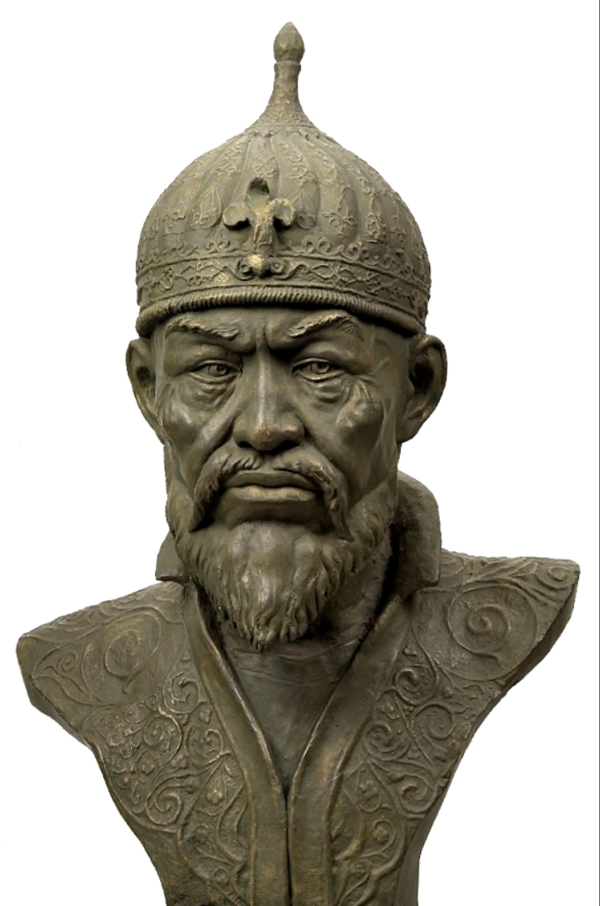
But it was the most recent invader, the Soviet Union, occupiers of Uzbekistan from the 1920s to 1991, which did its best to destroy not just his legacy but centuries of noble works and breathtaking art.
Observance of the Islamic faith was banned, the religious symbolism which graced the madrassas and mosques was belittled, decorations were obscured with white paint. Everyone was forced to speak Russian.
How fitting that a statue of Karl Marx in Tashkent’s main square has been replaced with a triumphant Timur.
Even now, 35 years on from the disintegration of the Soviet empire, conversations are prefaced with ‘since independence’ as the younger generation share their pride in the regeneration of those glorious buildings and speak proudly of the country’s heritage - the silks, ceramics, carpet, miniature paintings and embroidery, all so redolent of the Silk Road.
There is another ingredient which is just as vital to their sense of national identity: the food.
Again, the origins go back centuries to visitors - and invaders - from Turkey, Iran, and Morocco who introduced roast beef, lamb and horse meat, and China and other far eastern countries with their steamed dumplings and noodles.
Perhaps the best place to get a taste of the country’s food is the huge Chorsu bazaar in Tashkent built in uncompromising Soviet Brutalist style after the earthquake of 1966 which destroyed 90% of the city.
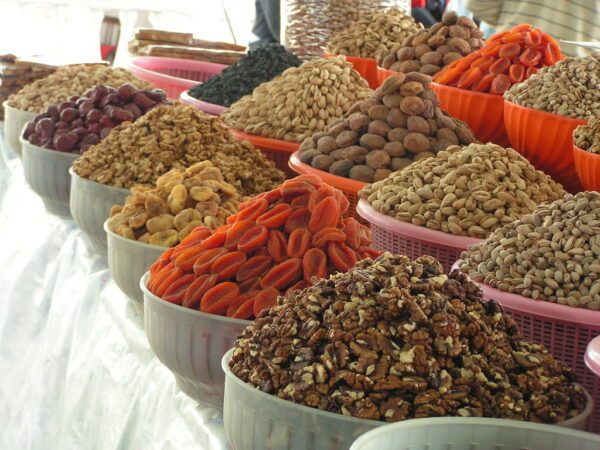
Under its spectacular dome, shoppers come to prod, squeeze and savour the pomegranates, grapes, melons and apricots; investigate the stalls laden with raisins, dried apricots and figs; and spice up their meals with cumin, coriander, turmeric and barberries, small and sharp.
Hillocks of almonds, pistachios, walnuts, sugar-coated nuts, raisins, dried apricots and figs, jostle alongside stalls of sweetness; halva, crystallised grape sugar, and sugar pillows wait seductively.
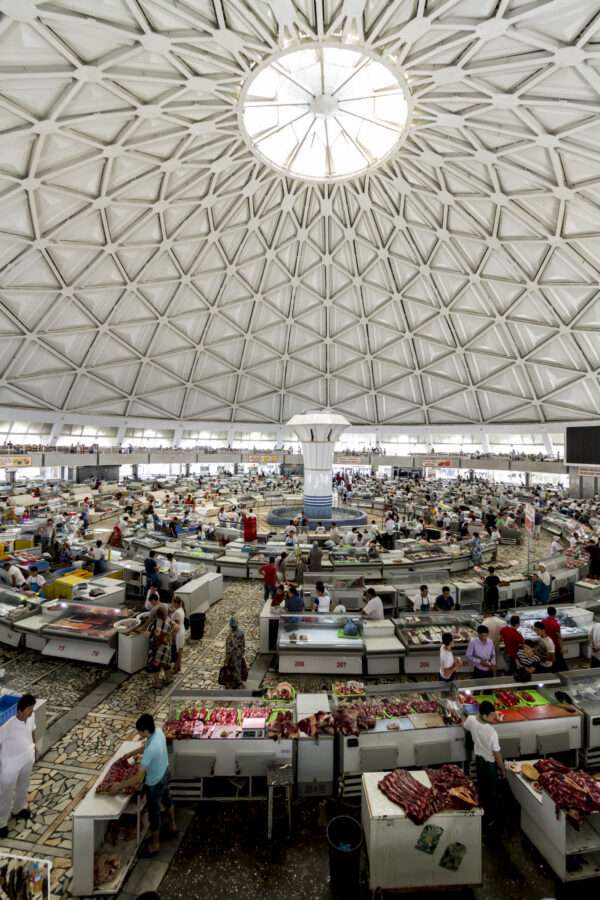
Butchers prepare the lamb, far and away the most popular meat, carve up hunks of beef and eviscerate horse carcasses with theatrical gusto. Intestines lie in fleshy knots, sheep’s heads grimace - not one for the vegetarian.
Peppers are piled high on the vegetable stalls, housewives check the aubergines, cauliflowers, cabbages, and buy stacks of carrots, yellow and orange, an essential for the making of plov.
Ah, plov. Not just the national dish but one which is listed on the UNESCO Representative List of the Intangible Cultural Heritage of Humanity, no less. Legend has it that the first plov was cooked by chefs in Alexander the Great’s marauding army in about 330 BC.
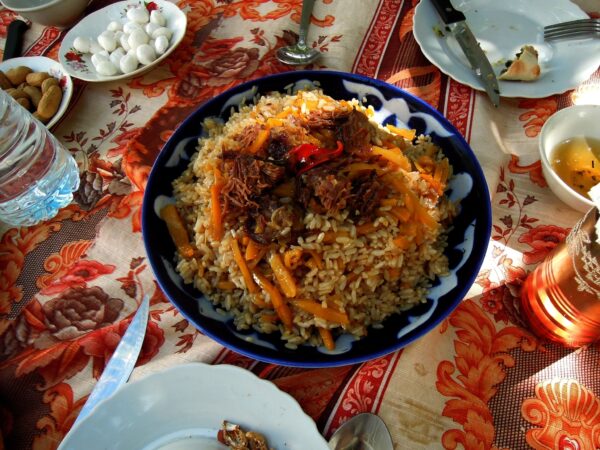
There are 200 ‘official’ recipes for plov, but it is essentially a simple rice dish with lamb, beef or horse, mixed with carrots, garlic, rice and cumin and cooked with oil or animal fat.
It does however vary from region to region. In Bukhara the ingredients are simmered in milk and water with aromatic spices and plenty of yellow carrots and nowhere does it taste better than in the scruffy Osh Markazi restaurant just outside the town centre.
In Samarkand the ingredients are layered rather than mixed with the meat, chickpeas and carrots and steamed on top of the rice, making it lighter and slightly less greasy than the Tashkent version in which the meat - horse is popular here - is blended with the rice.
For Tashkent’s most authentic plov try the boisterous dining area next to Chorsu where a blast of smoke and smells of meat roasting on open air barbecues mingles with the heat rising from the cauldrons of rice, drawing in the crowds who scramble for seats at the trestle tables.
Quails’ eggs are an added treat, which explains the ‘pok pok’ chorus made by the birds kept in tiny cages made of wood and fabric.
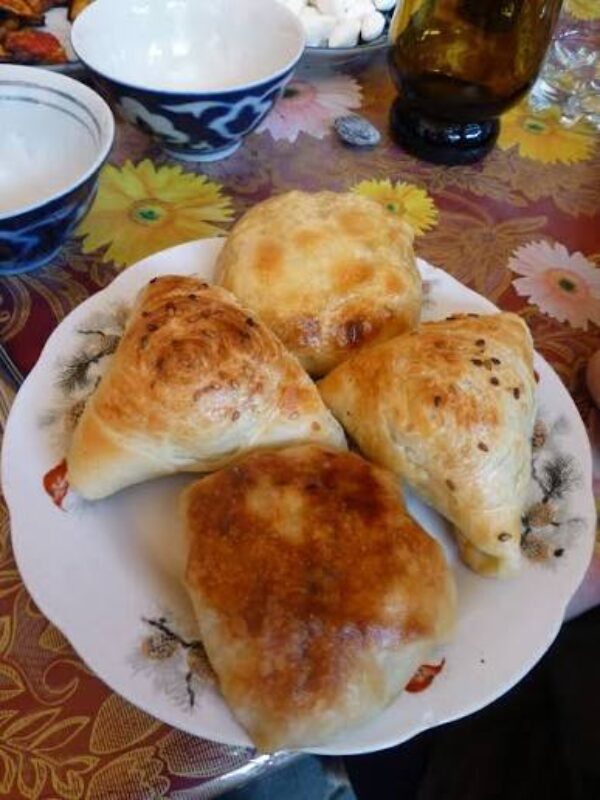
But there is more to the food than plov. Manti, a steamed meat dumpling stuffed with ground beef or lamb, served with yoghurt, garlic and cumin, was brought from the central Asia regions of Turkey and Armenia, while samsas, triangular shaped ‘envelopes’ of flaky pastry filled with minced meat, chicken or cheese and vegetables such as pumpkin, originated in Persia and are related to samosas, but baked, not fried. They were the ultimate convenience food for the hungry nomad or invading army.
You would expect to find shish kebab known here as shashlik and best enjoyed with rice and salads of yoghurt, cucumber, and tomatoes which are so fresh they are like a taste of summer.
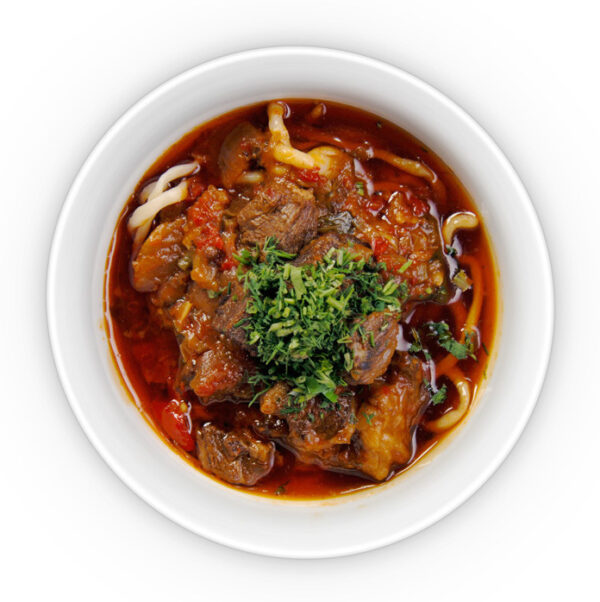
We had a spectacular feast of laghman, the traditional noodle soup piled high with lamb fried with onions, carrots, tomatoes and spices in a mountainside restaurant en route from Samarkand to Shahrisabz, where Timur’s birthplace is celebrated with a suitably grandiose monument. The barbecue sizzled, a stream cascaded between the tables, diners lounged in the shade on traditional tapchans, or divans, drinking green tea and eating shashlik with roundels of bread.
You soon realise no meal is complete without bread. In Chorsu alone, 16 ovens bake up to 10,000 loaves a day. Again, each region has its own taste. The Tashkent variety is made of flour, water, yeast and salt and baked in clay ovens to produce an irresistible flakiness. In Samarkand, in the lee of Timur’s majestic mausoleum, the market women set up their stalls to sell patyr, dough layered with mutton fat or butter and shreds of onion and herbs. The result, a thick crumbly crust and a chewy middle whereas in Khiva the bread is certainly chewy but without the lightness of the others.
The bread may differ and each region has its own take on plov, but the markets and restaurants stay true to their traditions. Even though this is a fast-moving country with a booming economy and, as if to prove it, everyone seems to drive a white Chevrolet, there is little culinary concession to western tastes.
You rarely see a McDonalds or a KFC, there are burgers, but they taste of meat unlike their Western rivals and inevitably there are pizza shops. Green and black tea is what you drink with most meals though there are restaurants which sell beer, particularly in the tourist areas. Give the wine a miss!
Oh, if you see a bull on the pavement, don’t panic. He’s just advertising a butcher’s shop before he joins his fellows as an ingredient in plov.
Getting there: Uzbekistan Airways from London Gatwick to Tashkent. Turkish Airlines also fly via Istanbul but treat with caution. Our return flight was cancelled on the morning of departure and replaced with a flight from a place we were not going to be in. No explanation, no recompense.
Contacts: Uzbek travel https://uzbek-travel.com/ (based in Tashkent). In the UK, Travel the Unknown, traveltheunknown.com.
For an insight into the contemporary art scene: https://www.thenewworld.co.uk/richard-holledge-the-artist-who-hid-his-best-work-under-a-desk/
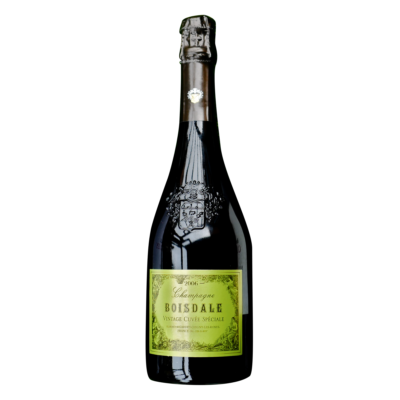
Comment for a chance to win a bottle of Vintage Champagne!
Send us a comment about this article, or ideas for future articles or interviews you would like to read. If we decide to publish any comments in future, you will win a bottle of Vintage Champagne.
Coming up at Boisdale
Discover what's going on across our famous venues
Membership
The Boisdale Club exists to generally encourage the enjoyment of life with a specific focus on delicious wine, Cuban cigars, Scottish malt whisky, live music and interaction between its members.
Please click apply now to find out more and sign up to the Boisdale Club.