Georgia On My Mind
Discover Georgia, the birthplace of wine, where 8,000 years of winemaking, spectacular landscapes, extraordinary food and legendary hospitality come together.

Bill Ktott
There is a famous Georgian myth surrounding the creation of their homeland. The story goes that God summoned all the peoples of the world, with the intention of distributing land to each of them.
The Georgians, however, were late. Their delegation had been taking part in a lengthy supra (the classic Georgian feast: they are always lengthy); carousing, singing, making toasts, feasting, and drinking copious quantities of wine.
God asked the tamada – the toastmaster, a key figure at a supra – the reason for their tardiness. He replied that they had been toasting God’s health and singing his praises so effusively that they had lost track of the time.
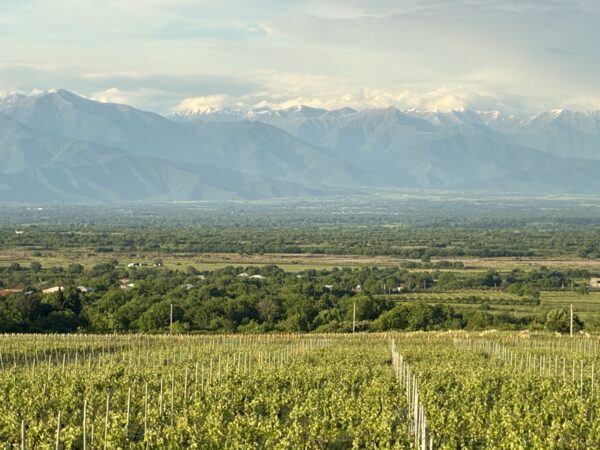
God was so amused and charmed by this response that he gave the Georgians the plot of land that he had reserved for himself: lush, fertile valleys, with a magnificent backdrop of snow-capped mountains.
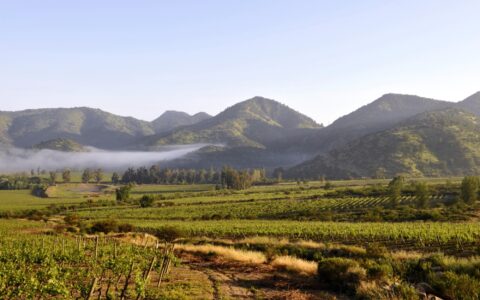
While the folklore may be a touch fanciful, the fertile valleys – the Alazani Valley, for instance, home to Kakheti, Georgia’s most important winemaking region – and the jagged Caucasus mountains are very much real, and remain a huge source of national pride.
That national identity has frequently been under threat. Georgia shares borders with Turkey, Armenia, Azerbaijan and Russia, and, over the centuries, its neighbours have been almost unremittingly noisy. Strategically located at the crossroads of Europe and Asia, in a narrow mountain corridor between the Caspian Sea and the Black Sea, it was, historically, a vital trade route.
In the 8th century BC, Georgia was invaded by the Urartians, the Scythians and the Cimmerians, then by Pompey and his forces in 65 BC, followed by various skirmishes with Islamic and Turkic invaders, eight separate invasions by the ruthless Timur, and, from the 16th to 18th centuries, much meddling by Ottoman Turks.
More recently, Georgia’s noisiest neighbour has been Russia. The Russian Empire annexed the country between 1801 and 1804; then, in 1921, the Red Army invaded, and Georgia was absorbed into the Soviet Union for the next 70 years. In 2008, Russia invaded the regions of South Ossetia and Abkhazia: although nominally independent, they are still effectively under Russian control.
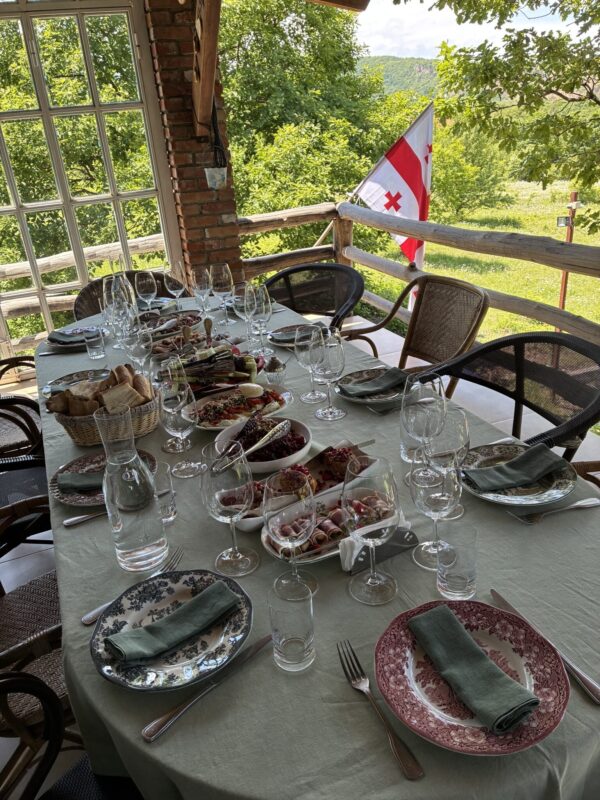
Remarkably, though, during all this turbulence, the resilient Georgians carried on growing their vegetables, making their wine, laying the table for their supras (supra literally means “tablecloth”), making toasts and singing hymns and folk songs: Georgia’s polyphonic singing is probably the oldest of its kind in the Christian world, and has been declared by UNESCO as an Intangible Cultural Heritage of Humanity.
The subject of some of these songs is the cult of the vine, and they date back to the 8th century. The history of the country’s winemaking, however, dates back much, much further: with recent archaeological evidence showing that Georgians were growing grapes and making wine by 6000 BC at the latest, Georgia is now considered to be the world’s “cradle of wine”.
Some of those unearthed artefacts were pottery jars, and the residue they contained indicated that Neolithic winemakers picked wild grapes specifically for fermenting wine, probably burying them in the ground to help stabilise the temperature over harsh winters and hot summers.
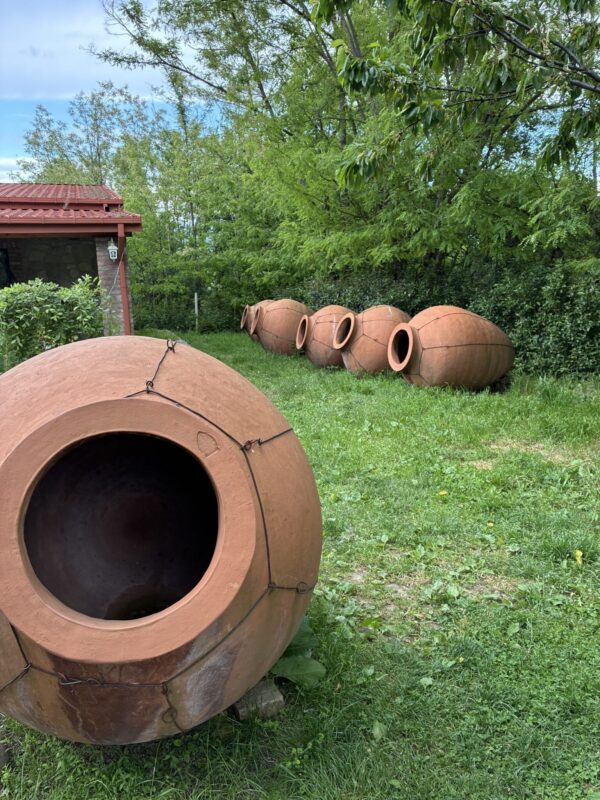
They are a direct precursor of kvevri: the beehive-shaped terracotta vessels, also buried in the earth, that are unique to Georgia and still used today; like their Neolithic ancestors, today’s Georgian winemakers usually leave the grape skins and pips in the fermenting wine: normal for red grapes, but giving white grapes an orange tinge, as well as more tannin: often called “orange wine” elsewhere in the wine world, Georgians prefer the term “amber wine”.
Amber kvevri wines from Georgia are now all the rage in trendy wine bars and restaurants around the world, but recognition for the country’s best vintages has come only recently. Once again, the Georgians were late to the party.
This time, though, it wasn’t their fault. The Soviet era was disastrous for the quality of Georgian wines. The entire process was nationalised, and production limited to just a handful of the highest-yielding grapes: for context, Georgia has an extraordinary 525 indigenous varieties, probably more than any other country in the world.
Wines, both red and white, were invariably made medium-sweet to cater for Muscovite tastes, and on an industrial scale; worse, the naturally fertile vineyards were drenched in pesticides and fertilisers to boost yields. And the ancient kvevri method was impractical commercially, so terracotta jars were supplanted by concrete tanks.
Even after the collapse of the Soviet Union, the Russians weren’t finished. In 2006, Russia banned imports of Georgian wine: at the time, more than 80% of the country’s wines (still mostly cheap, sweet and industrial) were bought by Russia.
But the ever-resilient Georgians weathered the storm. Even at the height of the Soviet domination of their winemaking, backyard production of wine had continued, often with a plethora of those 525 varieties, and often in kvevri. Scale this up to a more commercial scale, without compromising quality, and – so the idea was – Georgia could regain something of the reputation that its wines enjoyed before the Soviet era.
There were many hurdles to overcome, not least that very few kvevri were still being produced: the art had been almost lost. A new generation had to be taught how to source the right clay, how to build the huge pots, and how to fire them. Grape varieties on the verge of extinction needed to be preserved; most importantly, this new, back-to-the-future style of Georgian wine needed both a high-quality product and a sustained marketing drive to promote it to lucrative international markets.
The historical links between wine and the Georgian Orthodox Church are as thoroughly intertwined as the vines themselves, which is what took me to the Alaverdi Monastery in Kakheti, a few miles northwest of Telavi, the region’s main town.
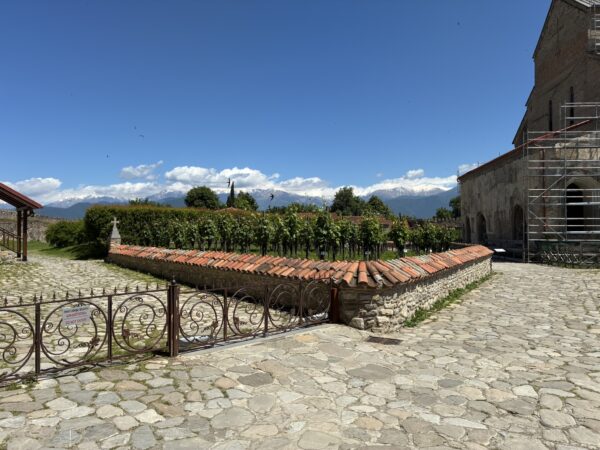
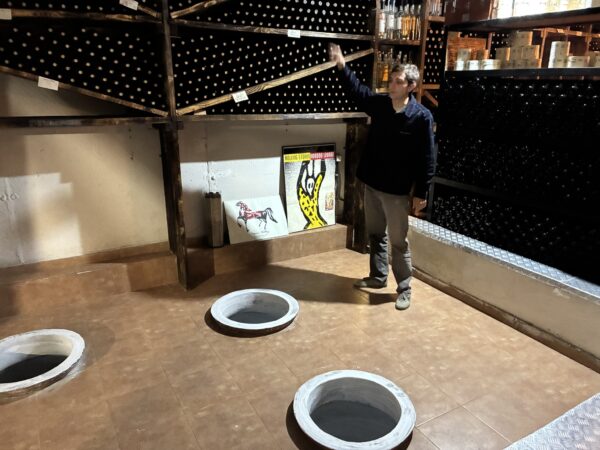
The 11th century cathedral is extraordinary, hugged by a bend in the Alazani river and towering 55 m above the valley floor, lofty and mystical, its walls adorned with medieval frescoes. The wine cellar is of a similar age, and it was here, in 2005, that the monks set about restoring both the cellar and 40 or so ancient kvevri, some now clustered in the monastery’s cloisters: the largest holds 400 litres.
They also took cuttings from ancient vines: 125 or so of them now populate a small vineyard just outside the cathedral’s imposing carved wood doors. With assistance from Badagoni, one of Kakheti’s most prominent wineries, the monks set about making kvevri wines that could command international attention.
Which, after a while, they did: notably, the Badagoni Alaverdi Tradition 2016 red wine, made in kvevri from Saperavi grapes, scored 97 points and won a platinum medal at the Decanter World Wine Awards. Just as importantly, the monks’ efforts served as a blueprint for a new generation of secular winemakers who could marvel at the ancient kvevri and discover long-neglected vines that their great-grandparents once tended.
One of those young winemakers is Sandro Kurdadze, a philosophy graduate who took over the reins at Papari Valley in 2022, the winery that his father Nukri established in 2004. Sandro and his father have 21 kvevri, and all their wines are made this way, the kvevri split between three terraces for fermentation, ageing, and – for their premium reserve wines – prolonged ageing.
Papari Valley’s winery is a modest operation, but set amongst the estate’s nine hectares of vines, with a terrace overlooking both them and the jagged-toothed Caucasus Mountains in the distance, it is also spectacular, and the wines – mostly ink-black Saperavi reds and complex, fragrant Rkatsiteli whites – are equally astounding, with wonderful depth and purity.
Sandro is also the chief viticulturist at Château Buera, the onsite winery at the Lopota Lake Resort and Spa, a breathtakingly beautiful resort in the heart of Kakheti. Lopota was the vision of one man, Goga Maisuradze, who bought a wild and overgrown lake in 2008 with the idea of turning it into a luxury resort that would showcase what Georgia in general and Kakheti in particular could offer the world, from traditional Georgian cuisine and wines (there are now seven restaurants dotted around the lake) to a Slavic bath house, stables for horses, an ice rink and several swimming pools.
Although the lake is now completely transformed from its neglected state 20 years ago, Maisuradze’s philosophy was very much to build his dream in harmony with nature. Guests can tour the 60-hectare estate, and the neighbouring countryside, on foot, horse, bicycle or quad bike, with the Caucasus mountains as a constant backdrop: for birdwatchers, anglers and naturalists, it is paradise.
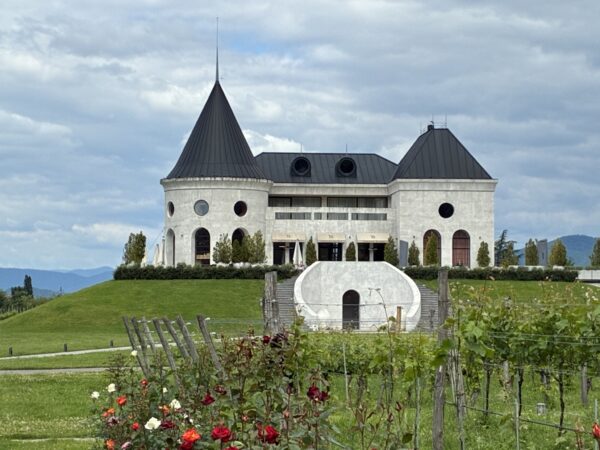
And at its centre is Château Buera, Sandro’s fiefdom. Papari Valley is modest; Château Buera is anything but: it has the aura of a grand château from the Loire, its slate-grey towers and grand double staircase reminiscent of Chenonceau and Chambord. Maisuradze opened it in 2018, making wine with grapes from nearby vineyards, and planted his own vineyard on the estate in 2020, the year before his untimely death. The resort is now owned and run by his daughters, Ana and Elene, together with Eka, their mother. Ana is married to Sandro, and it is very much a hands-on family business.
For me, the best restaurant at Lopota is Kakhetian Corner, where traditional Georgian food meets the wines from Château Buera and – if you are lucky, as I was – a troupe of Georgian male singers, their haunting, polyphonic harmonies wafting over a table laden with a culinary rainbow of dishes.
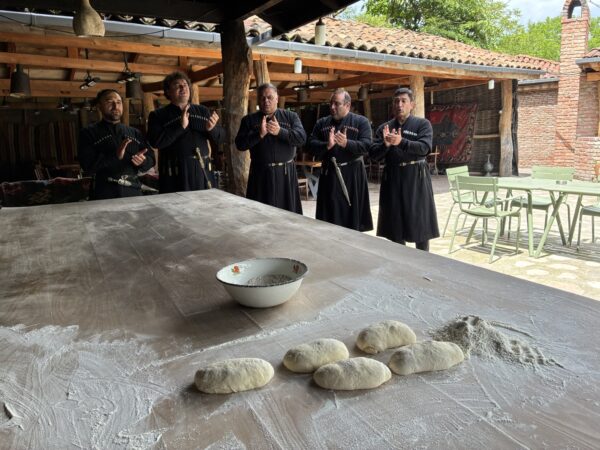
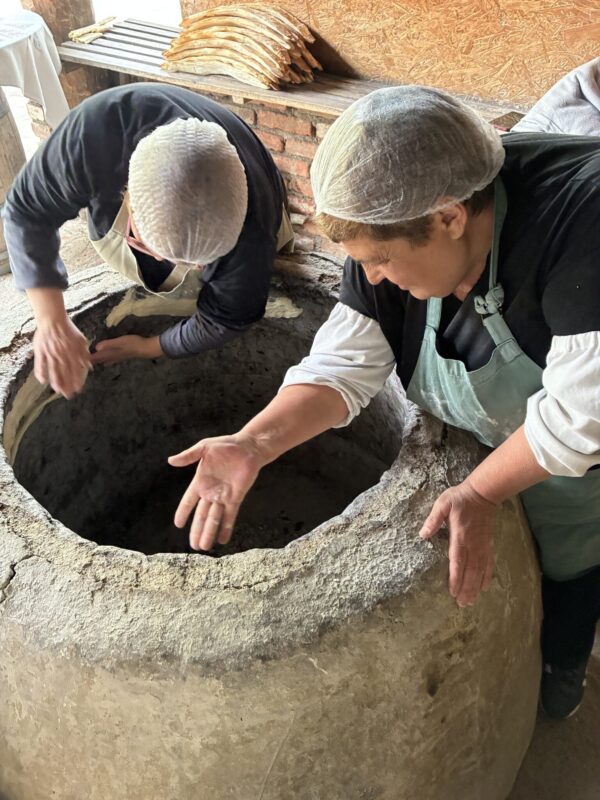
I had earlier tried my hand at two of them, under the watchful gaze of two beefy-armed Georgian women. Shotis puri is fluffy, crackling-crusted Georgian bread, the dough pulled and stretched into the shape of a canoe before it is slapped against the inside wall of a toné, a wood-fired, beehive-shaped oven with striking similarities to the Iranian tanur and the Indian tandoor, both of which are used to cook bread in a similar fashion. You could probably trace thousands of miles of the ancient spice route simply by following the smell of freshly-baked bread.
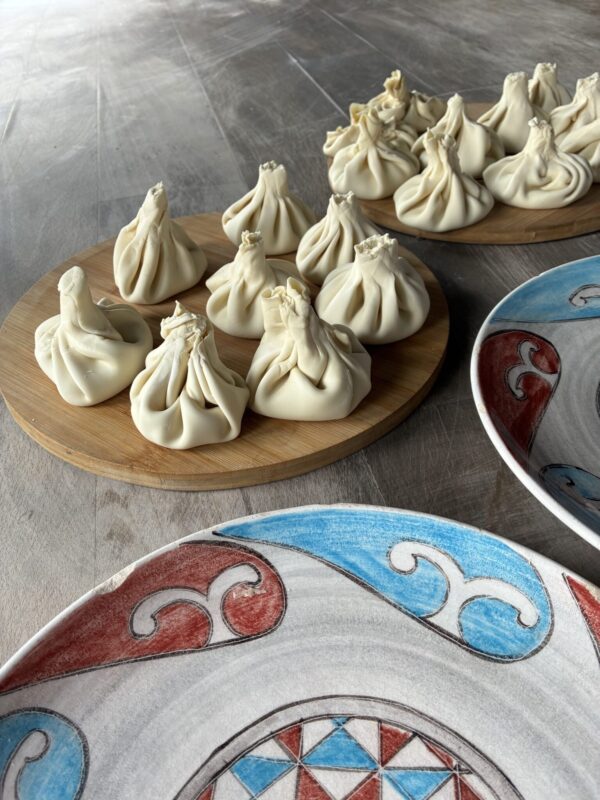
The other dish was khinkali, the soupy, meaty dumplings that are eaten throughout Georgia, although with many regional variations. There is, as I discovered, a distinct knack to pleating the pastry around the filling, one which I singularly failed to acquire; fortunately, the women had made some more professional examples.
They were joined on the table by spreads for the warm bread made variously from walnuts (which loom large in Georgian cuisine), cheese (ditto), spinach and aubergines, bejewelled with pomegranate seeds. There are pickled jonjoli (bladdernut) blossoms, pickled vegetables, the first of the season’s tomatoes... everything sings with freshness, as do the grills and skewers that follow: lamb, pork, veal, trout, served with lobio, the claypot bean dish that is on every Georgian menu, and tkemali, a bracingly tart sauce made from sour green plums.
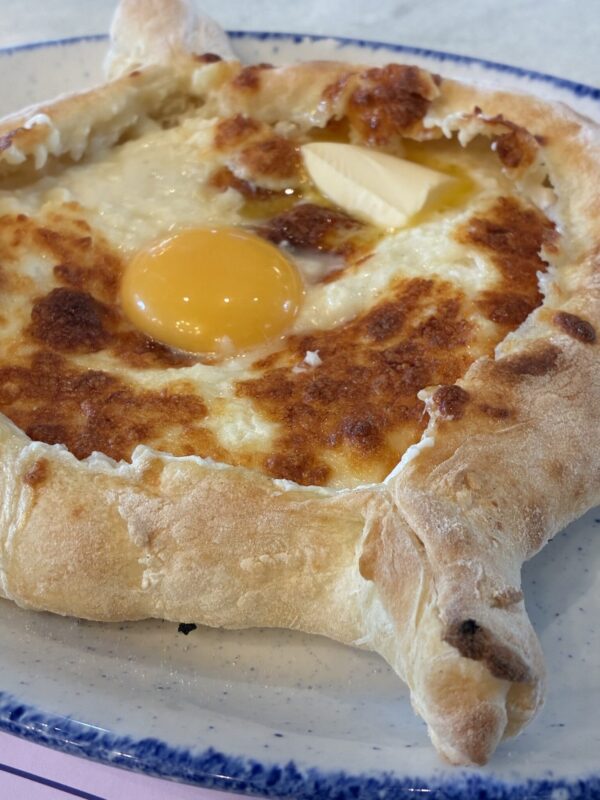
And there is khachapuri, perhaps Georgia’s most famous dish: cheesebread, with dozens of regional variations, of which the most famous is from Adjara, by the Black Sea: a boat-shaped bread filled with melted cheese, topped with an egg and a knob of butter. It is sinfully delicious. Wines are all from the Buera range and are very reasonably priced: around £15 for the standard range, £30 for the reserve wines.


Back at Papari Valley, Sandro’s mother Ketevan has prepared a superb supra for the family and their guests. Nukri, as the head of the family, is the de facto toastmaster, and we all make little speeches as the wine flows freely.
My contribution was to say that, in 30 years of writing about food and wine, I have been in tasting rooms where wine experts sniff, spit and scribble about first-growth clarets without any apparent pleasure, and in three Michelin-starred dining rooms where bored and very rich diners pick listlessly at caviar and truffles. The greatest pleasure of eating in Georgia, I tell the table, is that – while the food and wine are excellent – the sense of camaraderie, of hospitality, of warmth and generosity, is even more beguiling.
The conversation (particularly when the bottles of chacha, Georgian grappa, come out) veers exuberantly from philosophy to literature, from football to music. The wine-fuelled supra is a joyous expression of civilisation, of resilience and of national pride; and, after 8 000 years, the Georgians know a thing or two about all of that.
Top Stories

Featured
Comment for a chance to win a bottle of Vintage Champagne!
Send us a comment about this article, or ideas for future articles or interviews you would like to read. If we decide to publish any comments in future, you will win a bottle of Vintage Champagne.
Coming up at Boisdale
Discover what's going on across our famous venues

Membership
The Boisdale Club exists to generally encourage the enjoyment of life with a specific focus on delicious wine, Cuban cigars, Scottish malt whisky, live music and interaction between its members.
Please click apply now to find out more and sign up to the Boisdale Club.