
Bridge to Victory
How Montgomery Crossed The Rhine
Peter Wall
Ex-soldier and military historian General Sir Peter Wall served as Chief of the General Staff, the professional head of the British Army, until September 2014.
By the spring of 1945, Germany was under threat from both sides: in the east the Soviet Army was across the River Oder and poised to attack Berlin, whilst in the west, Eisenhower’s armies had the Germans pinned down on a broad front from the Low Countries to the Alps. Much of Europe lay in ruins, and everyone, soldier and civilian alike, wondered how much longer the war would last, and at what cost.
For Britain, the answer would come from one of the best-orchestrated operations of the war: the crossing of the Rhine, led by Field Marshal Bernard Montgomery. Success would allow the Allied armies to break into the heart of Germany and force the unconditional surrender of Hitler’s Third Reich.
The hard winter battles of 1944 had taken their toll. German forces had launched their final desperate attack in the Ardennes, the “Battle of the Bulge”, but by January 1945, they were spent: Hitler’s last gamble in the West had failed. The Allies pushed eastward until they reached the western bank of the River Rhine, Germany’s last great natural barrier.
The Rhine was not just another river. It was deeply symbolic of German identity, a line the Germans vowed would never be crossed: and it was 400 yards wide.
But Montgomery, commanding 21st Army Group, had other ideas. His plan, known as Operation Plunder, would send the British 2nd Army and the U.S. 9th Army across the Rhine near the industrial town of Wesel, while airborne troops would seize a bridgehead in a daring assault codenamed Operation Varsity.
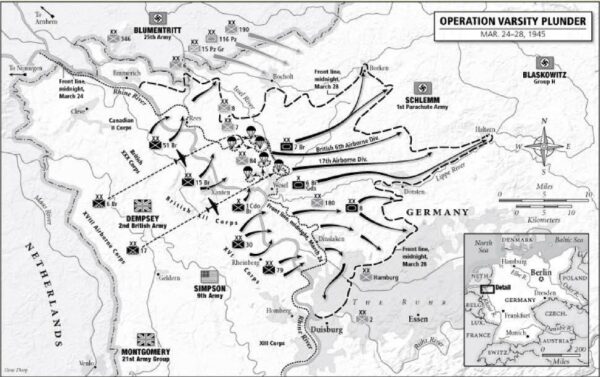
To cross the river and breach the heavy German fortifications, the British 2nd Army amassed 120,000 tons of ammunition, engineer stores, and special equipment. More than 60,000 combat engineers would participate in the assault, equipped with bridges, pontoons and specialist assault tanks, supported by 5,500 artillery pieces, anti-tank and anti-aircraft guns, and rockets. As Montgomery’s briefed his commanders:
“21st Army Group will now cross the Rhine. The enemy possibly thinks he is safe behind this great river obstacle. We all agree that it is a great obstacle; but we will show the enemy that he is far from safe behind it. This great Allied fighting machine, composed of integrated land and air forces, will deal with the problem in no uncertain manner.
“And having crossed the Rhine, we will crack about in the plains of Northern Germany, chasing the enemy from pillar to post. The swifter and the more energetic our action, the sooner the war will be over, and that is what we all desire; to get on with the job and finish off the German war as soon as possible. Over the Rhine, then, let us go. And good hunting to you on the other side.”
By mid-March 1945, Montgomery’s forces were arrayed along the Rhine’s western bank preparing for the assault, well protected by Allied control of the skies, for the Luftwaffe was a spent force.
The Germans opposing them were the battered remnants of General Alfred Schlemm’s First Parachute Army; they were exhausted, but still dangerous. They dug in along the eastern bank, determined to make the British and Canadians pay dearly for every yard of progress.
As darkness fell on 23rd March, the silence was broken and the night sky erupted in flame. British and Canadian guns delivered one of the heaviest bombardments of the war, pounding German positions.
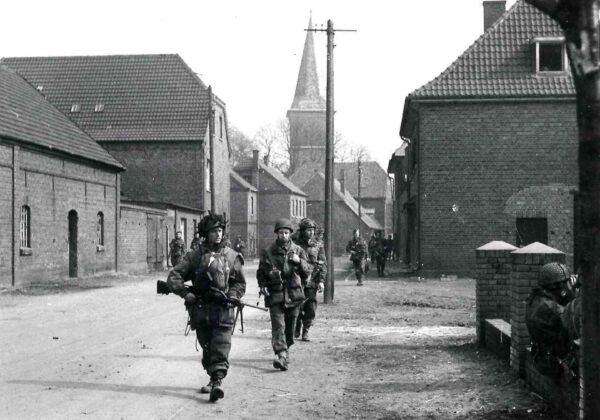
Just after midnight, assault troops pushed their boats into the river. Searchlights pierced the smoke to mark the way, as men of the 15th (Scottish) Division and the 51st (Highland) Division began their crossings near Rees and Xanten. German shells sploshed into the water; machine-gun fire rattled across the surface. Many boats were hit and men lost, but they pressed on. By dawn, bridgeheads had been secured, and engineers began building pontoon bridges under fire to get vehicles and logistic stocks across.
At first light on 24th March, thousands of paratroopers from the British 6th Airborne Division and the US 17th Airborne Division dropped behind German lines, 16,000 men descending from the sky in a hail of flak and tracer fire. They landed scattered and under heavy attack but quickly regrouped, capturing vital roads and bridges to stop German counterattacking towards the river.
Fierce fighting ensued on the eastern bank. German paratroopers, young, determined, and still disciplined, defended every village and wood-line. In ruined towns British troops fought street by street, clearing cellars and shattered buildings, the defenders refusing to yield until they were overwhelmed.
Allied firepower was devastating. Fighter-bombers screamed overhead, hunting down German vehicles. Artillery pounded every strongpoint. Within 24 hours the crossings were secure, and British armour was massing on German soil for the first time.
Montgomery’s meticulous planning, often criticised for its caution earlier in the war, had paid off. Casualties were far lighter than expected. The operation was a textbook example of Allied coordination between land and air forces, something that had proved elusive earlier in the war.
By 26th March, the bridgehead was more than ten miles deep. Resistance crumbled as Montgomery’s men surged forward, pushing eastwards into the German heartland alongside US forces who had crossed the Rhine further south.
For the soldiers, the Rhine crossings brought a strange mix of elation and weariness. Some had faced defeat at Dunkirk in 1940, then fought against Rommel in the western desert. Many had fought their way from Normandy, through Belgium and Holland, and now stood on the brink of victory. Within weeks, their advance would sweep through northern Germany, liberating cities like Bremen and Hamburg, and unearthing the full extent of Nazi evil at Bergen-Belsen. The crossing of the Rhine had opened the path to the final elimination of Hitler’s Reich.
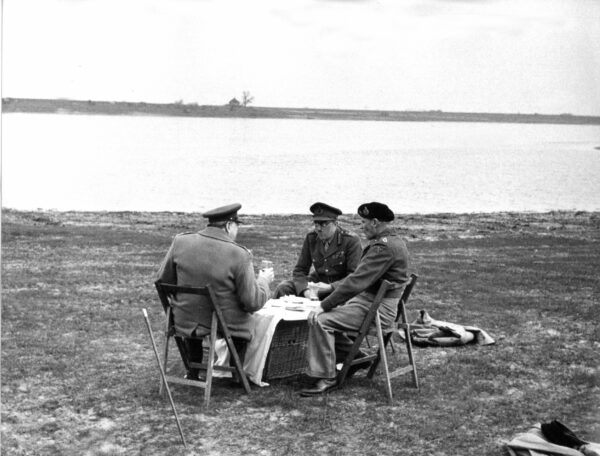
Watching the offensive from a forward vantage point at Rheinberg, Churchill commented to Eisenhower, “My dear General, the German is whipped. We have got him. He is all through.” Montgomery’s Operation Plunder was a symbolic triumph.
For the men who fought it, and for the families waiting at home, it was more than that. It was the moment when those who had confronted and survived the horrific challenges of WW2 at last had the end in sight.

Comment for a chance to win a bottle of Vintage Champagne!
Send us a comment about this article, or ideas for future articles or interviews you would like to read. If we decide to publish any comments in future, you will win a bottle of Vintage Champagne.
Coming up at Boisdale
Discover what's going on across our famous venues

Membership
The Boisdale Club exists to generally encourage the enjoyment of life with a specific focus on delicious wine, Cuban cigars, Scottish malt whisky, live music and interaction between its members.
Please click apply now to find out more and sign up to the Boisdale Club.