
The Two Bottle Lunch: Vivek Singh
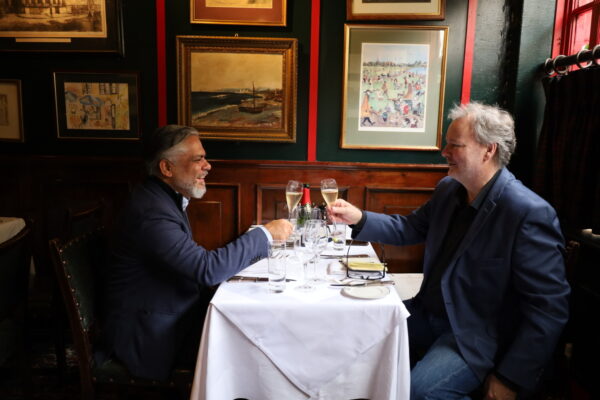
The Cinnamon Club’s Vivek Singh with Boisdale Life editor Bill Knott at Boisdale of Belgravia

Bill Knott
2026 marks the 25th anniversary of one of London’s most remarkable restaurants, even by the standards of a city in which dining out has become second nature.
The Cinnamon Club, which opened in 2001 on the site of the Grade II-listed Westminster Library, was not so much evolution as revolution. The co-founders, journalist and businessman Iqbal Wahhab and chef Vivek Singh, were determined to shatter any preconceptions of Indian food, both from Westerners and from Indians.
Vivek recalls their opening menu. “No pints of lager, and no curries. We were a poppadom-free zone. We wanted to focus our diners’ minds by taking things away.” Indeed, other than a pleasant waft of spice in the air, there was little sign that the handsome, high-ceilinged dining room, many of the library’s bookshelves still intact, was home to an Indian restaurant.
The tables were as smartly dressed as the (mostly Western) waiters; the wine list would have graced any Michelin-starred French restaurant; the produce had impeccable provenance; and Vivek’s plating was accomplished with a painterly eye for beauty and detail. You would scour the room in vain for a prawn vindaloo or an onion bhaji.
Now that London has Indian options at all levels, from street food and breakfasts (Dishoom’s all-conquering bacon naan roll springs to mind) to high-end restaurants (Amaya, Gymkhana and many others), it is difficult to remember just how polarised the Indian dining scene used to be.
2001 was a watershed. As well as the opening of The Cinnamon Club, Michelin handed out stars to two restaurants, Atul Kochhar’s Tamarind and Vineet Bhatia’s Zaika, and Indian restaurants had finally achieved gastronomic respectability.
But Vivek still remembers the struggle he had to convince his customers. “Western diners, whose idea of Indian food was based on their local curry house, thought it was too expensive and the portions were too small. Indians would say that their mothers cooked their favourite Indian food, and asked us why we were trying so hard.
“No challenge was greater than the idea that Indian cuisine should be inexpensive. But we were using top-notch ingredients – our seafood came from the same fishmonger as Gordon Ramsay, for instance – and we were paying our staff properly. You can’t do that on a curry house budget.”
But, in time, it worked. The Cinnamon Club now serves 100 000 diners a year, and Vivek also oversees Cinnamon Kitchens in Devonshire Square, Battersea and Leeds, as well as Cinnamon Bazaars in Richmond and Covent Garden. He has even relaxed his attitude towards curry: “eventually, we were comfortable and confident enough to put a curry or two on the menu. It helps that there’s a younger generation now whose mums didn’t cook for them!”
Vivek has come a long way from his roots. He grew up in a small mining community in West Bengal, where his father, a mining engineer, ran the local colliery, a prestigious position: “we were middle class, with a domestic staff of nine or 10”. Despite coming from a Hindu family, Vivek was educated at St Patrick’s in Asansol, a Christian Brothers school; after leaving school, he gained a place at the renowned Oberoi Institute of Hotel Management in Delhi, where “I sleepwalked through the course, until a friend dragged me into the kitchen, and I really enjoyed it.”
His first posting was at the Oberoi Grand in Calcutta, where he was keen to work in the kitchen of the hotel’s Indian restaurant. “But I lasted less than 18 months. I felt stifled: there was no experimentation. And there were rumblings of dissent: why aren’t we using the top-notch produce that the other kitchens have?”
In 1998, he was appointed the executive chef of Oberoi Rajvilas, in Jaipur, where – at a wedding – he met Iqbal Wahhab, and the seeds of The Cinnamon Club were planted.
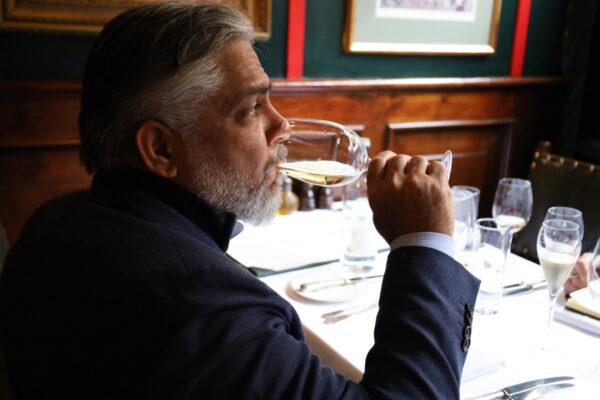
Now 54, no longer the fresh-faced 30 year-old who opened The Cinnamon Club – he now proudly sports an impressive grey beard – Vivek is a familiar face to millions of Saturday Kitchen viewers (“I must have done 60 or 70 shows”) and he still remains a deep love for the industry to which he has dedicated his life’s work. “I still do a couple of nights a week in the kitchen, just to make sure everything is running smoothly, that wastage is kept to a minimum and our ethos remains strong.”
There is no sense that he is resting on his laurels just yet, and he takes a keen interest in the burgeoning London Indian restaurant scene that he did so much to foster: Asma Khan, the founder of Darjeeling Express, and Will Bowlby, co-founder of Kricket, are both close friends. And he welcomes today’s more enlightened attitude to working in kitchens: “we used to work five split shifts and one straight shift a week, with a day and a half off if you were lucky. Today’s young chefs won’t stand for that, and they are quite right.”
So is London now the best city on the planet for Indian cuisine? Vivek smiles, a little ruefully. “I’ve got into trouble for this before. I do think London offers the best showcase for Indian food – we have such a long history together – but a lot has changed in 25 years. The world has shrunk, people travel much more, social media has revolutionised how we think and talk about restaurants, and there’s a real energy, pace and momentum about all kinds of cuisines now, including Indian.”
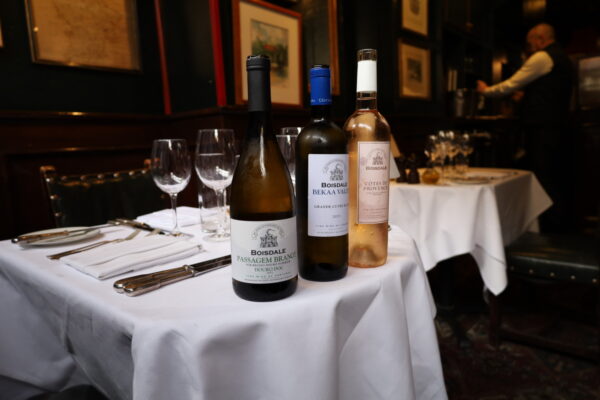
We got rather carried away at our supposedly “two bottle” lunch: it was lubricated by several wines from Boisdale’s own-label range, including a splendidly sappy and savoury Portuguese white – Passagem Branco – made by Quinta de la Rosa from grapes (Rabigato and Arinto) grown in the Douro; Boisdale’s NV Champagne, extended bottle age giving it a pleasingly toasty edge; the Bekaa Valley Grande Cuvée, made in Lebanon by Chateau Ksara from several white grape varieties, including a fragrant splash of Muscat; and the smooth, well-structured Boisdale own-label claret, which partnered our 35-day dry aged Scottish rib-eye magnificently.
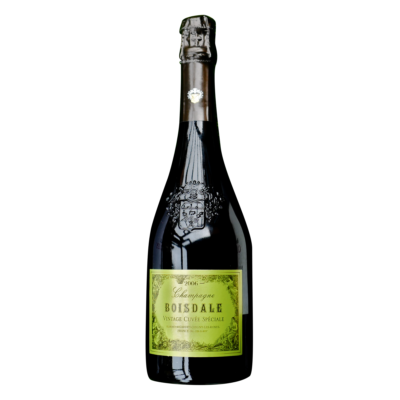
Comment for a chance to win a bottle of Vintage Champagne!
Send us a comment about this article, or ideas for future articles or interviews you would like to read. If we decide to publish any comments in future, you will win a bottle of Vintage Champagne.
Coming up at Boisdale
Discover what's going on across our famous venues
Membership
The Boisdale Club exists to generally encourage the enjoyment of life with a specific focus on delicious wine, Cuban cigars, Scottish malt whisky, live music and interaction between its members.
Please click apply now to find out more and sign up to the Boisdale Club.