
How To Bluff At... Cigars
The etiquette of the cigar aficionado
David Ellis
What does it say to smoke cigars? That you have no problem watching your savings go up in smoke. A cheap gag for what has become an expensive hobby, though admittedly one more easily accessed than say, space tourism.
Increasingly popular in the past few years, popular with both sexes and all ages, smoking a cigar is no longer the preserve of dissolute uncles at weddings and Christmas. Smoking can offer solitary moments of peace but, at its best, it is a social thing; it’s about sitting and chatting, even if those chats rather too often involve backgammon and school fees. But there’s an art to how to get away with it when the stickies are served.
Not such a puffed-up past
Knowing a little history makes for good cover on the hotel terrace if you’re confusing your Fonsecas with your Fuentes. It’s also handy for small talk in a tobacconist: show an interest, and you stand a better chance of finding the good stuff. Tobacconists are nerds at heart.
It’s a long story that originates not in Cuba, but what is now Guatemala, under Mayan rule. Their word for smoking – sikar, later cigarro in Spanish – is generally agreed to be the derivation of the word cigar. Some say the Mayans built theirs with tobacco strong enough to induce hallucinations; others insist it would have only been for medicinal purposes: honest, guv.
These Mesoamericans took their cheroots across South America and the Caribbean, still puffing them by the time Christopher Columbus arrived, and slowly tobacco began to spread through Europe. There is a story that the first man seen in Britain to smoke was a sailor in Bristol, spied emitting smoke from his nose. It was 1556: he must have seemed half dragon. There is more, but it is rather dry, the one thing a cigar should never be.
Does size matter?
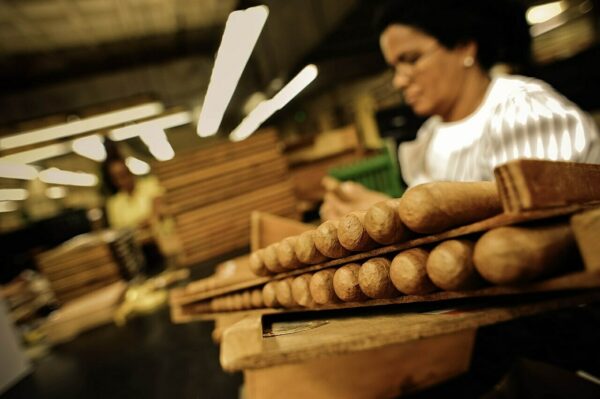
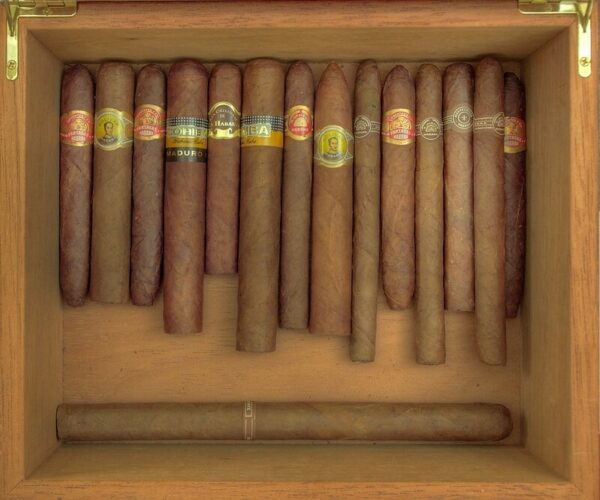
Is bigger better? Cigars come in all manner of shapes and sizes: there are, in fact, almost too many to mention, though the basic difference is between the parejo (straight-sided and cylindrical) and the figurado, easily recognised because it tapers at one end (or both).
Cigars are measured by ring gauge (diameter), and by length, always in inches. Make your own jokes if you must, but remember that “sometimes a cigar is just a cigar”, as Sigmund Freud probably never said.
The ring gauge is also in inches, specifically 1/64ths of them: popular styles are around 50-52. Size is an indication of how long a cigar will take to smoke (the bigger, the longer) but is rarely an indication of strength or flavour. All are made of a wrapper (the handsome brown leaf of the outside), a binder (its uglier compadre, lying underneath) and filler (the tobacco itself, which does all the actual work).
Strictly Cuban?
Yes, if you wish to annoy embargo-deprived American friends. Otherwise, it’s a little trickier. The Caribbean remains at the heart of all cigar manufacturing, and the main distinction is between Cubans and New World cigars, those from Nicaragua, the Dominican Republic or Honduras. Cigars are natural things, not full of the nasties that lurk in cigarettes, so “better” is actually a question of taste: terroir matters, as it does with wine.
The thing to know is that Cubans have had their reputation dented in recent years for being inconsistent to smoke but that, since the pandemic, things seem to be back on track. Cuban cigars have a rich, distinct flavour and character all of their own. The best tactic is to complain about the recent price hikes, mutter wistfully about when Cohibas were cheap and life was good, and tell everyone you have a man in Gibraltar.
It is foolish to generalise about New World cigars, but a safe gambit is to say that they are always tightly-constructed and smoke well. Those from the Dominican Republic are considered to be light and smooth to smoke; Hondurans are big and bold and often spicy; those from Nicaragua full-flavoured, and often strong. Say you’re getting into Ecuador, Costa Rica and Cameroon and most will nod sagely in agreement and skip swiftly onto something else.

What to choose?
Cigars are listed as mild, medium or full-bodied, or somewhere between them. It’s an indication of intensity: a mild cigar can have the same flavour as a full one, but the latter will have far more nicotine. This is not the time to play my-dad’s-harder-than-yours: mild cigars are best for new or infrequent smokers, as too much nicotine leaves anyone light-headed and nauseous; it can make the room spin (known to some as the “sangria effect” — the strength is fine till it’s not). This is countered fairly easily with sugar, but better just to choose the right cigar to begin with. Modesty will get you everywhere.
How to choose? Ask. Hoyo De Monterrey is a good go-to brand, known for light cigars with plenty of flavour; Davidoff has plenty of options too; so too Rafael Gonzalez. From there, Romeo e Julieta might be a good move, or Brick House. Where to shop? Buy them as you smoke them in Boisdale, of course. Out and about? James J Fox (call it JJ Fox); Davidoff, No 6 Cavendish, Sautter (Churchill had a flat above the shop… before it sold cigars), Turmeaus.
Going up in smoke
Cutting, lighting and smoking are the meat and potatoes of it all, though you wouldn’t want to discover either under the wrapper. A good cigar is about ceremony and preparation. Cigar merchants now often sell sticks with a humidor bag, which keep them fresh for a few weeks (much handier than popping them in fridges, a ruinous myth that once went around).
Cigars are best cut as close to smoking time as possible, but know that a bad cut will wreck even the best cigar, leading the wrapper to unravel, which ends up feeling like you’re endlessly licking an envelope. Not good.
Cigar cutters come in all forms, the most common being straight-cutters (they guillotine), V-cutters (they slice a little V into the stick) and punch cutters (which punch a small hole). Each has its advocates, although punch cutters, which offer the smallest hole to smoke through, are known for tar building up over the smoke. Not a flavour you’d call desirable, tar: unlikely to replace olives in a martini any time soon (of which: what to drink? Anything you like. But whisky, brandy and rum tend not to fight the smoke).
V-cutters are foolproof, and cut only a little of the wrapper off. Straights draw best. Where? Cigars have smooth domed heads, cut before the dome straightens out. Imagine them as little bald men, and scalp them right at the top of the forehead.
To light, take it slowly. Cigars get bitter when they burn too hot: to light, hold a match (or butane lighter — anything else will alter the flavour) as close to the foot of the cigar as you might marshmallows to a fire: the aim is to tease the ash into lighting, not to startle it with flame. Rotate the cigar to get it all lit, blow on the end and you’ll be good to go. To keep it burning steadily and without it getting overheated, don’t puff too often. Or too seldom: relighting doesn’t do the flavour much good, either. About once a minute is a good yardstick.
We won’t get into the world of mastering cigar ash – truly, life is too short – but as a general rule, leave the ash on as long as possible. Trying not to tap ash at all is a dangerous game to play if you value clothes without holes, skin without burns, or children without tears. To knock off the ash, roll the cigar end gently on the ashtray; a wheel will come off, as they so often do with well-made plans.
What else is there to know? Oh, a world. But cigar smoking is convivial, not competitive. Just tell everyone you always thought Frankau seemed a nicer chap than Hunter and that should do it. After all, an expensive cigar is best with a cheap gag
Comment for a chance to win a bottle of Vintage Champagne!
Send us a comment about this article, or ideas for future articles or interviews you would like to read. If we decide to publish any comments in future, you will win a bottle of Vintage Champagne.
Coming up at Boisdale
Discover what's going on across our famous venues
Membership
The Boisdale Club exists to generally encourage the enjoyment of life with a specific focus on delicious wine, Cuban cigars, Scottish malt whisky, live music and interaction between its members.
Please click apply now to find out more and sign up to the Boisdale Club.