
Close To The Wind
A newspaper editor walks a fine line between truth and trouble

Christian May
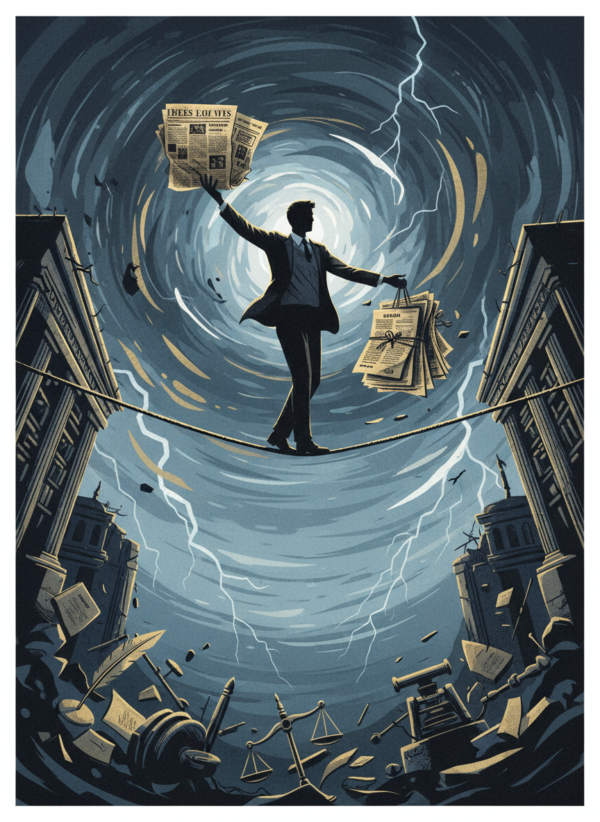
Over the years, I have developed a robust sense of whether a threatening legal letter needs to be taken seriously. And some of them are very threatening indeed.
Larger media organisations have in-house lawyers, but at City AM we have an excellent lawyer on a retainer, and I have reason to talk to him most weeks. It is those conversations that have honed my sense of whether we are gearing up for a fight or, as is increasingly the case, the furious legal bluster is actually just a PR response on steroids. As editor-in-chief, legal responsibility for all our published stories lies with me, and me alone. If things go wrong, I can’t blame a junior: this is not the Civil Service.
I think I can plot my trajectory as an editor through the various legal threats I have had to deal with: I may be a good judge of them now, but this wasn’t always the case. The first such letter I received made my blood run cold, and I still remember exactly where I was when I read it on my phone.
I had just moved into a bachelor pad in the heart of the Square Mile, having taken up the role of editor a month earlier. Frankly, my head was still spinning from the appointment. One day I was a 27-year-old PR guy in Westminster, and the next I was being unveiled as the new editor of City AM.
The decision by the newspaper’s owners to recruit someone as editor who had never worked as a journalist took plenty of people by surprise, none more than me. I’d spent a few years working in communications and lobbying for think-tanks, mostly of the free-market kind, and by the summer of 2015 I was Head of Communications and Campaigns at the Institute of Directors.
In that role, I often appeared in the media as a pundit and spokesperson but, while I had a Masters degree in journalism, I’d never really put it to use, other than by selling diary stories for beer money. So when City AM’s proprietors asked to meet me, I went along to dinner in a state of mild curiosity. I left, somewhat drunkenly, as their new editor.
I had no idea what I’d signed up to. I didn’t know what the editor’s job was, and I was more than a little concerned that the newsroom would raise a collective eyebrow at my inexperience. This wasn’t a case of imposter syndrome; it was a case of being an actual imposter.

Some sniffy media coverage of my appointment only added to my nerves, but support came from some unexpected places. The brilliant journalist and author Iain Martin, whom I’d never met, wrote me an email based on the eight pieces of advice that an editorial grandee had sent him when he also found himself promoted to a top newspaper job at a young age. I think of that letter often, and the act of kindness that lay behind it. Iain’s final piece of advice was: “Enjoy it, this will be the most fun you can have with your trousers on.”
He was right, but as I stood in my new flat reading the email from one of London’s most notorious law firms, I thought the fun (and my luck) had run out. The previous day we had run a story on a slump in the resale value of off-plan properties at the (then fledgling) Battersea Power Station development. Our irresistible headline was “Battersea Panic Stations”.
Unfortunately, they didn’t see the funny side. Their lawyers informed me that I would be held personally responsible for the multi-million-pound valuation hit. As I looked around my new City pad on a Friday evening, I thought, “well, it was good while it lasted.” Imagine my relief when our lawyer, Paul Fox, sent me a message saying “Don’t worry, it’s bollocks, they’re just angry. I’ll reply on Monday.”
That was more than a decade ago – since when, I’m pleased to say, Battersea has become a spectacularly successful showcase for redevelopment – and I went on to serve as editor for another five years, before hopping the fence for a career change in corporate communications.
The less said about that experiment the better, and I was delighted when City AM’s new owners invited me to take up the editor’s pen once again in the summer of 2024. Much had changed in my absence, largely thanks to Covid (again, the less said the better) but under new ownership and with a post-pandemic spring in its step, City AM had roared back to life and now, a year on, I think it’s in the best shape it’s ever been.
Paul Fox is still our lawyer, and we still have to talk to each other often. There was the murky world of whisky investments (Boisdale fans are surely too savvy to get roped in) and the increasingly threatening objections of the subject of our investigation.
There was the international banking executive who didn’t like one of our stories. There was the well-known company whose six-page letter amounted to a scream of frustration. There was the multi-layered investigation into various shenanigans at a listed UK firm.
And these are all just from recent weeks. Often, we send stories to Paul for his approval, pre-publication, and while he might suggest a sharpening or a softening of tone, generally he replies with a thumbs-up.
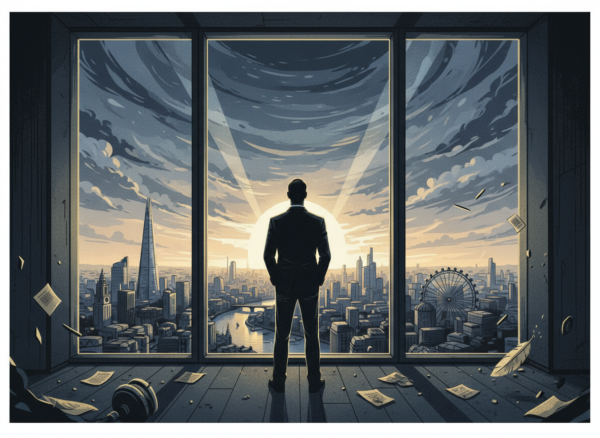
Mindful as I am of tempting fate, I’d like to point out that, on my watch, we have never been taken to court or successfully challenged. What I have noticed is that many people and businesses bypass traditional PR or communications advisors and reach straight for the menacing lawyer.
This is a mistake. I can think of several occasions where I might very well have reacted reasonably to a polite phone call pointing out a client’s perspective and asking for a modest clarification or shift in emphasis: I am a reasonable man. But I cannot give in to threats and fury. From the moment I read “we hereby demand the article is removed immediately” my sinews stiffen. There’s always a chance that we are in the wrong and, of course, mistakes do happen, but I will not accept threatening letters as a substitute for polite engagement.
My attitude towards legal threats is far from the only thing that has changed since I edited my first edition on Sunday 17th August 2015. The Square Mile has changed, for a start. A decade ago I couldn’t even get a Starbucks coffee in the City on a Sunday (working on Monday’s edition), whereas today the City’s often busiest on the weekend.
Canary Wharf has evolved, too, as has our approach to publishing. Before the pandemic I used to say to the owners “I think we should have an app” and they’d reply, “why would we encourage people not to pick up the newspaper?”
Today, having launched our app just over a year ago, it has been downloaded more than 250,000 times. And we’re still printing. Our focus is obviously a lot more digital, and we pump out videos from our own studio in the heart of the City.
The economics of news publishing has also shifted (it will never be static) and we now have to contend with a world going crazy for Artificial Intelligence which can, I regret to say, often lead to artificial news clogging up other parts of the digital sphere.
How do we retain trust? How do we earn the loyalty of readers? How do we monetise a product that, for 20 years, has been free to read? These are mighty questions with no easy answers, but City AM has some hard-won advantages as we navigate the new landscape. We’re agile, we’re entrepreneurial, we’ve got supportive and patient owners and, perhaps most importantly, we’ve got a personality and a reputation.
We strive to add value to the issues and stories we cover and add some fun to the world of business and financial journalism. We have to have faith that this approach will continue to resonate with our audience, even as we cut a path towards the future through the jungle of AI.
Elements of that technology are supremely useful to journalists (deep research and data analysis), and other elements are great for our consumers, such as personalising news feeds, or translating stories to audio or foreign languages. But one of my many jobs is to make sure that, amid this constant and necessary experimentation, we know where we’re going and that we don’t get distracted by noises off. Or, for that matter, by angry lawyers.

Comment for a chance to win a bottle of Vintage Champagne!
Send us a comment about this article, or ideas for future articles or interviews you would like to read. If we decide to publish any comments in future, you will win a bottle of Vintage Champagne.
Coming up at Boisdale
Discover what's going on across our famous venues
Membership
The Boisdale Club exists to generally encourage the enjoyment of life with a specific focus on delicious wine, Cuban cigars, Scottish malt whisky, live music and interaction between its members.
Please click apply now to find out more and sign up to the Boisdale Club.